


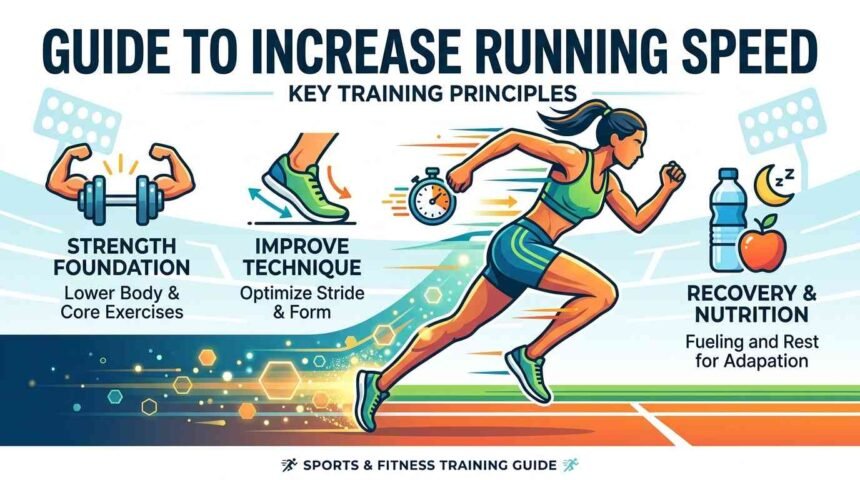
Learning how to increase running speed is one of the most valuable things any athlete can work on, whether you’re a footballer trying to beat defenders, a track runner chasing a personal best, or simply someone who wants to move faster and more efficiently. Speed isn’t just a natural gift handed to a lucky few — it’s a trainable skill built from a combination of running technique, strength, mobility, and structured practice. With the right approach, most athletes can meaningfully improve their running speed within a matter of weeks.
This guide breaks down exactly how to increase running speed step by step: the technique fixes that make the biggest difference, the specific drills and workouts proven to build speed, the strength training that underpins fast running, and a sample weekly plan you can follow to put it all together. Whether you’re sprinting 40 yards on a football pitch or chasing a faster 5K time, the fundamentals covered here apply directly to your goals.
What Actually Makes You Run Faster?
Running speed comes down to two simple variables multiplied together: stride length (how far you travel with each step) and stride frequency (how many steps you take per second). Elite sprinters don’t just take longer strides or turn their legs over faster than everyone else — they optimize both at once, which is why speed training focuses on improving running mechanics, ground contact time, and the force your muscles can generate with every stride, rather than simply “trying harder” to run fast. Understanding this distinction matters because it explains why the methods in this guide are split across several different training types — technique work, interval training, maximum-velocity drills and strength training — rather than a single catch-all “run faster” workout.
Coaches and sports scientists agree that speed is a trainable, technical skill rather than a fixed trait. As running coach Pete Magill explains in his coaching guide to building running speed, speed sits at the core of performance whether you’re training for a short sprint or a long-distance race, because efficient, powerful leg turnover benefits every type of runner. That means the technique and strength work covered in this guide isn’t just for sprinters — it carries over into every running-based sport, from football and basketball to track and field.
The Four Phases of a Sprint
Understanding the distinct phases of a sprint helps explain why speed training uses so many different types of drills rather than just “running fast” repeatedly. Sports scientists generally break a sprint down into four phases, each of which responds to slightly different training methods:
- Reaction and start. The initial push-off from a stationary or near-stationary position, driven by a powerful first step and strong forward lean.
- Acceleration (0-20m approx). The phase where stride length and ground force build rapidly with each step, typically trained through resisted sprints, short accelerations and strength work.
- Maximum velocity (20-40m+ approx). The point where stride length and frequency stabilise at their peak, trained specifically through flying sprints and overspeed methods.
- Speed maintenance / deceleration. The phase where fatigue begins to reduce stride quality, most relevant to longer sprints and repeated-sprint sports like football, where the ability to maintain speed across multiple efforts matters more than any single maximal sprint.
Most amateur athletes only train the acceleration phase, simply because it’s the easiest to replicate in short training spaces — but genuinely increasing running speed requires deliberately training all four phases, which is exactly what the step-by-step methods below are built around.
Step 1: Build a Strength Foundation Before You Sprint
Before jumping straight into all-out sprint sessions, it’s worth building a base level of strength and stability, particularly if you haven’t done structured speed work before. Running at top speed places enormous force through your muscles, tendons and joints, and a body that isn’t prepared for that force is far more likely to get injured than to get faster.
A simple two-to-three-week foundation phase focused on lower-body and core strength — squats, step-ups, single-leg deadlifts, hamstring curls, and plank variations — prepares your muscles and connective tissue for the demands of sprint training that follows. Skipping this step is one of the most common reasons athletes plateau or get injured when they try to increase their running speed too aggressively, too soon. Our strength and conditioning guides on Sports Tamasha cover a range of beginner-friendly programs if you’re starting this foundation phase from scratch.
Step 2: Fix Your Running Technique and Form
Technique is where most amateur runners leave the most speed on the table. A few key form adjustments make an outsized difference:
- Drive your knees forward, not just up. Powerful sprinting comes from driving the knee forward and down into the ground with force, rather than simply lifting the knee high with no forward drive behind it.
- Land under your hips, not out in front. Overstriding — landing with your foot far ahead of your body — acts like a brake with every step. Aim to land with your foot roughly underneath your centre of mass.
- Drive your arms aggressively. Your arms aren’t just for balance — driving your elbows back hard helps generate the rotational power that feeds directly into leg turnover speed.
- Stay tall through your torso. A slight forward lean from the ankles (not the waist) helps you use gravity to your advantage, while a hunched or collapsed torso restricts your stride and breathing.
- Relax your face, neck and shoulders. Tension anywhere in the upper body bleeds into the rest of your running mechanics and wastes energy that could otherwise go into speed.
Working on coordination and balance is just as important as any single cue, since good sprinting mechanics rely on multiple small adjustments working together rather than one isolated fix. For footballers specifically, pairing this running technique work with our football-specific fitness and agility guides on Sports Dastak helps translate straight-line speed gains into match situations involving changes of direction.
Speed Training for Different Sports
While the underlying principles of sprint technique remain the same across sports, how you apply them can differ. Football, rugby and basketball players rarely sprint in a straight line for more than 20-30 metres before changing direction, reacting to an opponent, or stopping suddenly — meaning acceleration, multi-directional speed and repeated-sprint ability matter more than pure top-end velocity. Track sprinters, by contrast, benefit enormously from dedicated maximum-velocity work over longer, unbroken distances, since races are decided by sustained top speed rather than reactive bursts.
Team-sport athletes should weight their training slightly more toward acceleration drills, resisted sprints, and short, sport-realistic sprint distances with direction changes, while still including some pure maximum-velocity work to build an overall speed ceiling. Endurance runners, meanwhile, benefit from speed training primarily as a way to improve running economy and top-end pace, even though their races rarely require sprinting at true maximum effort for extended periods.
Step 3: Add Sprint Interval Training
Interval training — alternating short, high-intensity sprints with recovery periods — is widely considered the single most effective method for increasing running speed. Rather than running continuously at a moderate pace, interval sessions force your body to repeatedly reach near-maximum effort, which is exactly the stimulus needed to improve both your top speed and your ability to sustain fast running.
A simple, proven structure for beginners:
- Warm up thoroughly with 10-15 minutes of easy jogging and dynamic stretching.
- Run at 80-90% effort for 20-30 seconds.
- Walk or jog slowly for 60-90 seconds to recover.
- Repeat for 6-8 rounds.
- Cool down with 5-10 minutes of easy jogging and static stretching.
As you progress, gradually increase the intensity toward 100% effort on your sprint intervals while keeping recovery periods generous — speed training is about quality, near-maximal efforts, not accumulating fatigue. This is a very different stimulus from endurance training, and mixing the two without a clear structure is a common reason athletes fail to see speed improvements despite training hard, a point echoed in Coach the Run’s breakdown of interval training for speed.
A Proper Warm-Up Routine for Speed Sessions
Sprinting at or near maximum effort without an adequate warm-up is one of the fastest routes to a hamstring or calf strain, so warm-up quality deserves the same attention as the main session itself. A well-structured speed-session warm-up typically includes:
- 8-10 minutes of easy jogging to raise heart rate and core temperature.
- Dynamic mobility work targeting the hips, hamstrings and ankles — leg swings, walking lunges, high knees and butt kicks.
- Activation drills such as A-skips, B-skips and short build-up strides at 60-80% effort.
- Two to three progressively faster strides of 20-30 metres, building toward but not reaching full sprint effort.
Only after this progression should an athlete attempt a sprint at 90-100% effort. Rushing straight from a light jog into a maximal sprint is one of the most preventable causes of soft-tissue injury in speed training.
Step 4: Train Maximum Velocity With Flying Sprints
One of the most effective — and most overlooked — ways to build genuine top-end speed is the flying sprint, sometimes called a “fly-in” sprint. Rather than sprinting from a dead stop, you build up to top speed over 15-20 metres before hitting a marked zone, then sprint through that zone at your absolute maximum speed for another 20-30 metres, followed by a long, full recovery of two to three minutes between reps.
This method isolates and trains maximum velocity specifically, rather than acceleration, which is a distinct physical quality. Because the reps are performed at true maximum effort with full recovery, volume should stay low — four to six reps is plenty for a single session — with the emphasis entirely on quality and technique rather than fatigue. This mirrors the approach used in structured sprint technique workouts designed for team-sport athletes, which prioritise clean mechanics over sheer repetition count.
Step 5: Use Resisted and Assisted Sprints
Once a base level of sprint technique and strength is in place, resisted and assisted sprinting methods can add a further layer of speed development:
Resisted Sprints
Sled pushes, resistance bands, parachutes, or uphill sprints all add extra load to the sprinting motion, forcing your muscles to generate more force with every stride. This is particularly effective for improving acceleration — the first 10-20 metres of a sprint — since it directly trains the powerful, forward-driving mechanics needed to get up to speed quickly.
Assisted (Overspeed) Sprints
Downhill sprinting on a very gentle slope, or being towed slightly faster than your natural top speed, trains your nervous system and muscles to move at speeds beyond what you can currently produce unaided. This method should be used sparingly and with a shallow gradient or light assistance only, since excessive speed or steep downhill running can quickly compromise technique and increase injury risk.
Step 6: Strength Train for Speed, Not Just Size
Strength training underpins every other element of speed development, because faster running ultimately comes down to producing more force into the ground in less time. The two most effective exercises for building this kind of speed-strength are heavy deadlifts and weighted squats, since both directly train the hip and glute power that drives explosive stride force.
A simple, effective structure is three sets of six to ten reps at a weight that genuinely challenges you by the final rep, performed once or twice a week alongside your running sessions — enough to build strength without leaving your legs too fatigued for quality sprint work. Glute-focused accessory work, including glute bridges and single-leg variations, is also worth adding, since the glutes are one of the primary muscle groups responsible for generating forward propulsion during sprinting.
Step 7: Train Hills for Both Strength and Speed
Hill sprints are one of the most efficient ways to build speed, because the incline naturally forces more powerful knee drive and forward lean while reducing the impact stress that comes with flat-ground sprinting at maximum effort. A simple hill session involves finding a moderate incline and performing repeated 8-10 second sprints at maximum effort, walking back down for a full recovery between each rep.
Because hill sprints are inherently lower-impact than flat sprinting at full speed, they’re also a useful way to introduce high-intensity speed work to athletes returning from injury or newer to structured sprint training, before progressing to flat-ground maximum velocity work. On Running’s guide to running at your fastest highlights hill sprints as one of the quickest ways to build both strength and speed simultaneously, without the equipment or space demands of resisted sprint setups.
Common Myths About Running Speed
A few persistent myths often steer athletes away from effective speed training:
- “Speed can’t be trained, you’re either born fast or you’re not.” While genetics do influence an athlete’s ceiling, structured technique, strength and interval training reliably improve running speed for the vast majority of athletes, regardless of natural ability.
- “More running automatically makes you faster.” High-volume, moderate-pace running builds aerobic endurance, not top-end speed — genuine speed development requires dedicated, near-maximal effort work, not simply accumulating more easy miles.
- “Heavy lifting makes runners slow and bulky.” Strength training focused on power and explosiveness, done alongside running, improves speed rather than hindering it, provided volume and intensity are balanced sensibly with sprint sessions.
- “You should sprint every single training day to get faster.” Because speed training relies on the nervous system performing at its best, daily maximal sprinting without adequate recovery typically leads to plateaus or injury rather than continued improvement.
A Sample Weekly Speed Training Plan
Here’s a simple weekly structure that combines the elements above into a program most athletes can follow for 6-8 weeks to build noticeable improvements in running speed:
- Day 1 — Sprint Technique & Acceleration: Technique drills, resisted sprints or short 10-20m accelerations, 6-8 reps.
- Day 2 — Strength Training: Squats, deadlifts, single-leg work, core stability.
- Day 3 — Active recovery or easy aerobic running.
- Day 4 — Maximum Velocity Session: Flying sprints, 4-6 reps with full recovery.
- Day 5 — Hill sprints or interval training.
- Day 6 — Strength training or mobility work.
- Day 7 — Rest.
Adjust the volume and intensity based on your current fitness level and sport-specific demands — a footballer preparing for a season will structure this differently from a track athlete peaking for a single race, but the underlying principles of technique, acceleration, maximum velocity, and strength remain the same across every sport.
Common Mistakes That Slow Down Your Progress
- Doing too much volume at low intensity. Speed training is about quality, near-maximal efforts with full recovery — turning every sprint session into a fatigue-based endurance workout undermines the entire purpose of the training.
- Skipping the strength foundation. Sprinting at maximum effort without adequate strength and conditioning significantly increases injury risk, particularly hamstring strains.
- Overstriding. Reaching too far forward with each step acts as a brake and is one of the most common technical flaws limiting running speed.
- Neglecting recovery. True speed work relies on your nervous system performing at its best, which requires full recovery between reps and adequate rest between sessions — under-recovered athletes rarely see genuine speed gains.
- Ignoring nutrition and sleep. Recovery and nutrition, particularly adequate carbohydrate intake and sleep, play a direct role in how well your body adapts to speed training and how quickly you see results.
Nutrition and Recovery for Speed Development
Speed training places significant demand on your nervous system and muscles, and recovery is where the actual adaptation — getting faster — takes place. A balanced diet with adequate carbohydrates supports the high-intensity efforts speed training requires, while sufficient protein supports muscle repair between sessions. Prioritizing 7-9 hours of quality sleep is equally important, since much of the neuromuscular adaptation that improves sprinting speed occurs during deep sleep rather than during the training session itself, a point that gets overlooked far too often in athletes chasing quick results through training alone.
Active recovery days — light jogging, mobility work, or complete rest — should be built into any speed program rather than treated as optional. Athletes who train at high intensity without adequate recovery windows often plateau or regress, since the nervous system needs time to fully recover between maximal-effort sessions. For more on structuring recovery alongside high-intensity training, see our recovery and conditioning section on SportsNewsEra.
Footwear and Equipment Considerations
While technique and training structure matter far more than gear, appropriate footwear does play a role in speed development. Lightweight, well-fitted running or sprint shoes with adequate traction allow for more efficient ground contact and force transfer than heavy, poorly-fitted footwear. For athletes doing resisted sprint work, a properly fitted harness or sled attachment reduces the risk of poor posture compensations that can develop from improvised resistance setups, and it’s worth investing in proper equipment once resisted training becomes a regular part of your routine rather than an occasional add-on.
How to Test and Track Your Running Speed
Tracking progress is essential for knowing whether your speed training is actually working, and it doesn’t require expensive equipment. A simple, repeatable testing protocol includes:
- 40-yard or 30-metre sprint test. A standard measure used widely in football and American football to assess straight-line acceleration and speed; time it with a stopwatch or phone timer from a stationary start, using the same starting method every time for consistency.
- Flying 20m test. Build up to full speed over 10-15 metres, then have a partner time only the following 20 metres to isolate your maximum velocity separately from acceleration.
- Repeated sprint test. For team-sport athletes, timing 5-6 short sprints with brief recoveries measures how well speed holds up under fatigue, which is often more relevant to match performance than a single maximal sprint.
Testing every 3-4 weeks, under similar conditions (same surface, footwear and warm-up), gives a much clearer picture of progress than testing randomly or comparing times across very different conditions. Keeping a simple log of your times alongside the training you were doing at the time also helps identify which methods are working best for your individual body, and makes it far easier to spot a plateau early enough to adjust your program before weeks of training go to waste.
The Mental Side of Sprinting Faster
Technique and physical conditioning aren’t the only factors behind running speed — the mental approach to sprinting matters more than most athletes realise. Tension is one of the biggest hidden speed-killers: athletes who consciously “try” to sprint harder often tense their upper body, clench their jaw, or hunch their shoulders, all of which restrict the very mechanics needed to actually move faster. Elite sprinters are frequently coached to stay relaxed even at top speed, trusting the technique they’ve trained rather than forcing extra effort through tension.
Confidence and rhythm also play a role. Athletes who sprint hesitantly, second-guessing their technique mid-stride, rarely produce their fastest times compared with those who commit fully to a rep once they’ve begun. This is part of why a consistent warm-up and pre-sprint routine matters — it builds the same kind of trust and automaticity in sprinting that a free-kick taker builds in their run-up before striking a dead ball.
Speed Training for Beginners vs. Experienced Athletes
How aggressively you can approach speed training depends heavily on your training background. Beginners with little prior sprint experience should prioritise the strength foundation phase, technique drills, and lower-volume interval sessions for the first several weeks, resisting the temptation to jump straight into resisted sprints or maximal-effort sessions before their body is prepared for that intensity.
Experienced athletes with a solid strength and sprint technique base can incorporate more advanced methods earlier — resisted and assisted sprints, higher-intensity interval structures, and sport-specific repeated-sprint work — since their tissues and nervous system are already conditioned to handle near-maximal efforts safely. Regardless of experience level, the core principle remains the same: progress the intensity and complexity of speed work gradually, rather than attempting advanced methods before the fundamentals are solid.
How Long Does It Take to Get Noticeably Faster?
Most athletes following a structured speed program can expect to see measurable improvements in acceleration and sprint times within 4-6 weeks, with more significant gains developing over a full 8-12 week training block. Sprinting faster does not happen overnight, and consistency across weeks — not the intensity of any single session — is what ultimately determines how much speed an athlete gains over a training cycle.
Frequently Asked Questions About Increasing Running Speed
The questions below cover the details most athletes and parents of young athletes ask once they’ve started a structured speed program, from training frequency to how quickly results typically show up.
How can I increase my running speed quickly?
The fastest way to see improvement is combining sprint interval training with basic strength work and running form fixes — most athletes notice measurable gains in acceleration within a few weeks of consistent, focused training rather than random, unstructured sprinting.
Does strength training actually help you run faster?
Yes — strength training, particularly exercises like squats and deadlifts, directly improves the force your muscles can generate into the ground with each stride, which is one of the core physical qualities underpinning running speed.
How often should I do speed training?
Two to three dedicated speed sessions per week, spaced with adequate recovery and strength training days in between, is a sustainable structure for most athletes looking to increase running speed without risking overtraining or injury.
What is the difference between acceleration and top speed?
Acceleration is how quickly you reach your top speed from a standing or slow start, typically over the first 10-20 metres, while top speed (or maximum velocity) is the fastest pace you can sustain once fully up to speed — both require slightly different training methods to improve.
Can running speed be improved at any age?
Yes, athletes of nearly any age can improve their running speed through structured technique, strength and interval training, though the rate and ceiling of improvement naturally varies based on training history, age and individual physiology.
Is it better to sprint on a track, road or grass?
Grass and track surfaces are generally preferred for maximum-effort sprint training because they offer more consistent footing and lower impact than hard road surfaces, though technique and training structure matter far more than the specific surface chosen.
Should I test my speed before starting a training program?
Yes — recording a baseline time using a simple test like a 30-metre or 40-yard sprint gives you a clear reference point to measure progress against over the following weeks, rather than relying on how training simply feels.
Can changing direction ability be trained alongside straight-line speed?
Yes, and for most team-sport athletes it should be — agility and change-of-direction drills complement straight-line speed work well and are often more directly transferable to match performance than pure top-speed training alone.
Final Thoughts on Increasing Your Running Speed
Learning how to increase running speed comes down to a handful of well-established principles: building a strength foundation, fixing your running technique, training both acceleration and maximum velocity through structured interval and sprint work, and giving your body the recovery it needs to actually adapt. There’s no shortcut that replaces consistent, well-structured training, but athletes who commit to a proper program — rather than simply running hard without direction — consistently see measurable improvements within weeks. Start with the fundamentals in this guide, track your progress using the testing methods above, and build speed training into a sustainable, long-term part of your overall fitness routine, adjusting the balance of technique, strength and interval work as your experience and goals evolve.
Related Reading
- More Fitness & Speed Training Guides on SportsNewsEra
- Athlete Training Tips on Sports Tamasha
- Speed & Conditioning Guides on Sports Dastak