


If you have ever watched a match and wondered why the score jumps from 15 to 30 to 40, you are not alone. How tennis scoring works confuses almost every new fan at first. The good news is that the system is logical once you see the pattern. Tennis is scored in four layers: points, games, sets and matches. Each layer builds on the one before it.
This guide explains how tennis scoring works from the ground up. You will learn what love, deuce and advantage mean, how a tiebreak is played, and why some matches last three sets while others last five. You will also see how the four Grand Slams handle the deciding set, how doubles scoring differs, and how to follow any scoreboard with confidence.
By the end, you will understand the tennis scoring system well enough to follow a live match, keep score in your own games, and explain it to a friend.
Tennis Scoring at a Glance
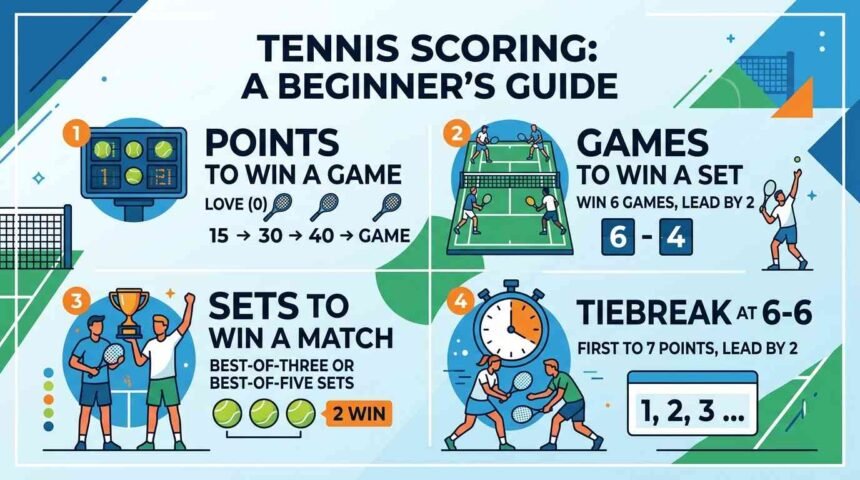
Before we go deeper, here is the short version. Players win points to win games. They win games to win sets. Finally, they win sets to win the match. That is the whole structure.
- Point: Each rally ends with one player winning a point.
- Game: The first player to win four points, with a two-point lead, wins the game.
- Set: The first player to win six games, with a two-game lead, wins the set.
- Match: The first player to win two sets (best-of-three) or three sets (best-of-five) wins the match.
The LTA’s guide to scoring in tennis describes the same four stages. Once you remember them, the rest of the rules are just details.

| Level | What You Need to Win It | Typical Score |
|---|---|---|
| Point | Win the rally | 0, 15, 30, 40 |
| Game | Four points, win by two | Game won at 40-30, 40-15, etc. |
| Set | Six games, win by two (or win a tiebreak) | 6-4, 7-5, 7-6 |
| Match | Two or three sets, depending on format | 6-4, 3-6, 7-5 |
The Four Levels of Tennis Scoring
Every tennis match is a nested contest. A match contains sets. A set contains games. A game contains points. Because of this, a player can win more total points than an opponent and still lose the match. Momentum matters less than winning the right points at the right time.
This is why tennis feels different from sports like football or basketball. In those sports, total points or goals decide the winner. In tennis, timing decides it. A player who wins the big points in each game will usually win the match, even with fewer points overall.
How Points Work: Love, 15, 30 and 40
Inside a game, points are counted in a way that looks odd at first. Instead of 1, 2, 3, the count goes 15, 30, 40. Here is how it works.

- No points: called “love”
- First point: called “15”
- Second point: called “30”
- Third point: called “40”
- Fourth point: wins the game, if the player is ahead by two
The server’s score is always called first. So if the server has won two points and the receiver has won one, the score is “30-15.” If the receiver leads, the score might be “15-30.”
Why Is Tennis Scored 15, 30, 40?
Nobody knows the exact origin. The most popular theory links the numbers to a clock face. Scorekeepers may have moved a hand to 15, 30, 45 and then 60. Over time, 45 was shortened to 40 because it is quicker to say. Whatever the reason, the tradition stuck. It has been part of the sport for centuries.
What Does “Love” Mean in Tennis?
“Love” means zero. A score of “30-love” means the server has 30 and the opponent has nothing. Many people believe the word comes from the French word for egg, “l’oeuf,” because an egg looks like a zero. That story is popular, but historians are not sure it is true. Either way, “love” is the official word for zero in tennis.
Deuce and Advantage Explained
Winning a game requires four points and a two-point lead. This rule creates deuce and advantage, two of the most confusing terms for beginners.
What Is Deuce?
Deuce means the score is tied at 40-40. Both players have won three points. Neither can win the game with the next point alone. Instead, someone must win two points in a row.
What Is Advantage?
Advantage means a player has won the point right after deuce. The score is called “advantage” (or “ad”) for that player. If that player wins the next point, they win the game. If they lose it, the score goes back to deuce.

This can repeat many times. A single game can go to deuce five, ten or even twenty times. That is why some games last a few minutes and others last much longer.
Ad-In and Ad-Out
You may also hear “ad-in” and “ad-out.” Ad-in means the server has the advantage. Ad-out means the receiver has it. These terms appear often in club tennis and doubles.
A Sample Game From Start to Finish
Let us walk through one game so the rules feel concrete. Player A serves against Player B.
- Player A wins the first point. The score is 15-love.
- Player B wins the next point. The score is 15-all.
- Player A wins two straight points. The score is 40-15.
- Player B wins two straight points. The score is 40-all, which is deuce.
- Player A wins the next point. The score is advantage Player A.
- Player A wins again. Player A wins the game.
Notice that Player A needed two points in a row after deuce. That is the two-point rule in action.
How a Set Is Won
A set is a group of games. To win a set, a player must win six games and lead by at least two games. So 6-3 and 6-4 are wins. A score of 6-5 is not enough, because the lead is only one game.
If the score reaches 6-5, the leader can serve for the set. If they win that game, the set ends 7-5. If they lose it, the score becomes 6-6, and a tiebreak usually decides the set.
Common Set Scores
- 6-0: known as a “bagel”
- 6-1: known as a “breadstick”
- 6-2, 6-3, 6-4: ordinary wins
- 7-5: won after trailing or tying at 5-5
- 7-6: won by a tiebreak
Because a set needs a two-game margin, you will never see a final set score of 6-5. The two possible endings after 5-5 are 7-5 or a tiebreak at 6-6.
Tennis Tiebreak Rules Explained
A tiebreak is a special game that decides a set when the score reaches 6-6. It stops sets from dragging on forever. The USTA’s scoring rules set out the standard procedure, and most tournaments follow it.
How Points Are Counted in a Tiebreak
In a tiebreak, you do not use 15, 30 and 40. Instead, points are counted 0, 1, 2, 3 and so on. The first player to reach seven points, with a two-point lead, wins the tiebreak. That player also wins the set, 7-6.
If the score reaches 6-6 in the tiebreak, play continues until someone leads by two. A tiebreak can therefore end 7-5, 8-6 or even 15-13.
Who Serves in a Tiebreak?
The serving pattern in a tiebreak is different from a normal game.
- The player whose turn it is to serve serves the first point.
- Their opponent then serves the next two points.
- After that, each player serves two points in a row.
This pattern keeps things fair. It gives each player the same number of serves over the course of the tiebreak.
When Do Players Switch Ends?
During a tiebreak, players change ends after every six points. For example, they switch when the score reaches 3-3 or 4-2. This reduces the effect of sun, wind or court conditions.
What Happens After a Tiebreak?
Once the tiebreak ends, the set is over. The player who served first in the tiebreak receives serve in the first game of the next set. The scores then reset for the new set.
Advantage Sets vs Tiebreak Sets
Not every event uses a tiebreak at 6-6. Some formats use an advantage set instead. In an advantage set, players keep playing until one leads by two games. The set score can reach 8-6, 10-8 or even 16-14.
Advantage sets were once common in the final set of major tournaments. They produced some of the longest matches in history. The 2010 Wimbledon match between John Isner and Nicolas Mahut lasted more than eleven hours because the final set had no tiebreak. Since then, tournaments have added tiebreaks to keep matches from stretching out too long.
A tiebreak set, by contrast, has a clear limit. The set ends when someone wins the tiebreak. Because of this, tiebreak sets are easier to schedule and less tiring for players.
Match Formats: Best-of-Three vs Best-of-Five
A match is won by winning a set number. There are two common formats.
- Best-of-three sets: the first player to win two sets wins the match.
- Best-of-five sets: the first player to win three sets wins the match.
Most professional matches use best-of-three. Women’s matches, including at the Grand Slams, are best-of-three. Men’s matches at the four Grand Slams are best-of-five. Most other men’s tour events use best-of-three.
Best-of-five matches test stamina as much as skill. They can last four or five hours. For this reason, the men’s Grand Slam matches often produce dramatic comebacks. Governing bodies such as the International Tennis Federation publish the official rules for these formats.
How the Grand Slams Handle the Final Set
The four Grand Slams are the Australian Open, the French Open, Wimbledon and the US Open. Each event once had its own way of finishing a deciding set. That created confusion for fans.
In 2022, the four majors agreed on one shared approach. When a deciding set reaches 6-6, a 10-point tiebreak is played. The first player to reach ten points, with a two-point lead, wins the match. The USTA notes this change in its guide to scoring.
This unified rule makes the biggest tournaments easier to follow. It also protects players from extreme fatigue in very long deciding sets. Always check the current rulebook of the event you are watching, though, because organisers can update the details from year to year. The official sites for Wimbledon, the ATP Tour and the WTA Tour list their current formats.
How Serving Affects Tennis Scoring
Serving is the way every point starts. The rules of the serve affect the score directly, so they are part of understanding how tennis scoring works.
Two Serves per Point
Each player gets two chances to land a serve inside the correct service box. If the first serve misses, the player takes a second serve. This is called a fault when the serve is missed.
Double Fault
If both serves miss, that is a double fault. The receiver wins the point automatically. A double fault can swing a game quickly, especially at deuce or on break point.
What Is a Let?
A let happens when the serve touches the net but still lands in the correct box. The serve is replayed, and it does not count as a fault. Lets can also be called for outside interference. The point is simply replayed.
Alternating Service Games
Players take turns serving each game. One player serves a full game, then the other serves the next. Within a game, the server alternates between the right side and the left side of the court after each point. The first point is served from the right, the second from the left, and so on.
Holding and Breaking Serve
When a server wins their own service game, it is called a hold. When the receiver wins a game on the server’s serve, it is called a break. Because the server has a natural advantage, a break is a big moment. Many sets are decided by a single break.
Changing Ends: When Players Switch Sides
Players switch ends of the court after the first game and then after every two games. They switch after games 1, 3, 5 and so on, whenever the total number of games is odd. This rule evens out conditions like sun and wind over the course of a set.
Players also take a short break during these changeovers. They can sit down, drink and dry off. The rest time is limited, so the match keeps moving.
Break Point, Set Point and Match Point
Certain points carry extra pressure. Commentators use special terms for them.
- Break point: the receiver is one point away from winning the game on the server’s serve.
- Game point: a player is one point away from winning the game.
- Set point: a player is one point away from winning the set.
- Match point: a player is one point away from winning the match.
- Championship point: match point in a final.
A single point can be several things at once. For example, at 5-4 and 40-15, the server has a game point and a set point. Winning it wins both the game and the set.
Scoring in Doubles
Doubles tennis uses the same basic scoring as singles. Points, games, sets and matches work in the same way. However, a few details are different.
- Teams of two play on a wider court that includes the outer tramlines.
- Each partner serves in turn, so service rotates among all four players.
- Many events use a “no-ad” system, described below.
- Many events replace the final set with a 10-point match tiebreak.
The score is still called with the serving team’s number first. The court is bigger and the pace is quicker, but the counting stays the same.
Alternative Scoring Formats
Tennis is played in many formats. Some are used in professional events. Others are used in clubs, schools and youth tennis. Here are the most common alternatives.
No-Ad Scoring
In no-ad scoring, there is no advantage. When the score reaches 40-40, one deciding point is played. The receiver chooses which side to receive on. Whoever wins that point wins the game. This format shortens matches and is popular in doubles and college tennis.
Match Tiebreak (Super Tiebreak)
A match tiebreak replaces the final set. The first player or team to reach ten points, with a two-point lead, wins the match. It is common in doubles and in club events.
Short Sets and Fast4
Short sets are played to four games instead of six. Fast4 tennis, for example, uses short sets with no-ad scoring and a tiebreak at 3-3. These formats suit beginners and busy players.
Pro Sets
A pro set is one long set, usually played to eight games. The winner needs eight games with a two-game lead, or a tiebreak at 8-8. Pro sets are popular for exhibitions and casual play.
Mini Tennis for Kids
Young players often use lighter balls and smaller courts. Their scoring is simpler too. Many youth programmes use short sets or a single match tiebreak. This makes the game quicker and less confusing.
Tennis Scoring Terms Glossary
Here is a quick reference for terms you will hear often on TV and at the club.
- Ace: a serve that the receiver cannot touch.
- Bagel: a set won 6-0.
- Breadstick: a set won 6-1.
- Break: winning a game when your opponent serves.
- Deuce: a game tied at 40-40.
- Fault: a serve that misses the service box.
- Hold: winning a game when you serve.
- Let: a serve that clips the net and lands in; it is replayed.
- Love: zero.
- Rally: the exchange of shots during a point.
- Tiebreak: a special game played at 6-6 in a set.
- Unforced error: a mistake made without pressure from the opponent.
- Winner: a shot the opponent cannot return.
A Full Set Walk-Through
Let us put everything together with an example set. Two players, Alex and Sam, play a best-of-three match. Alex serves first.
- Alex holds serve in game one. The score is 1-0 to Alex.
- Sam holds serve in game two. It is 1-1.
- Alex holds again and leads 2-1.
- Sam breaks Alex in game four. It is 2-2.
- The players trade holds until 5-5.
- Alex wins game eleven, so Alex leads 6-5.
- Sam holds in game twelve. It is 6-6.
- A tiebreak begins. Alex wins it 7-4, so Alex wins the set 7-6.
Alex now leads the match one set to love. The next set starts at 0-0, and Sam serves first, because Alex began the tiebreak by serving.
Common Misunderstandings About Tennis Scoring
New fans often get a few things wrong. Here are the most common ones.
“Winning More Points Means Winning the Match”
Not always. A player can win more total points and still lose. The winner is whoever wins the required number of sets, not whoever wins the most points.
“40 Comes After 30, So the Next Point Wins”
No. At 40, a player needs one more point to win the game only if the opponent has fewer than 40. If both are at 40, the game goes to deuce and needs a two-point lead.
“A Tiebreak Uses the Same Scoring as a Normal Game”
It does not. In a tiebreak, you count 1, 2, 3, not 15, 30, 40. The winning target is also seven points instead of four.
“The Score Is Always Called in the Same Order”
In a game, the server’s score comes first. In a set, the score is usually read as games won by the leader or by the server, depending on the announcer. Check the scoreboard to be sure who is who.
How to Read a Tennis Scoreboard
A tennis scoreboard shows a lot of information in a small space. Most boards look like a small table. Each row lists one player or team. Each column shows a set, with the current game score at the end.
For example, imagine this line: Player A: 6 4 3 30. It means Player A won the first set 6-4, is currently at 3 games in the second set, and has 30 points in the current game. Player B’s row would show the matching numbers.
A small dot or icon usually marks who is serving. Many broadcasts also show a tiebreak score in small print next to a set score, such as 7-6 (5). The number in brackets shows the loser’s points in the tiebreak.
Tips for Keeping Score in Your Own Matches
Keeping score at the club is harder than it looks. Players forget the score, especially after long rallies. These simple habits help.
- Call the score before every serve. Say the server’s number first.
- Agree with your opponent. If you disagree, replay the game from the last agreed point.
- Use a scoring app or a scoreboard. Many free tools track points for you.
- Know your format. Decide before you start whether you are playing a tiebreak, a no-ad game or a pro set.
- Write down the set score. It is easy to lose track of games during a long match.
Good habits make the game more fun. They also prevent arguments, which is a big part of good tennis etiquette. For more practical guides, browse our tennis section on Sports Tamasha.
Why Tennis Scoring Feels So Dramatic
Many fans love tennis because of the way the scoring builds pressure. A player can dominate a set and still lose it in a tiebreak. A player can trail by a break and then win five games in a row. Every point matters, but some points matter far more than others.
This structure explains why comebacks are so common. A player who is down two sets can still win in five. A player who is down a break can still win the set. Because of the two-point and two-game margins, no lead is completely safe until the final point.
If you enjoy following the sport, you can find match reports, previews and guides on SportsNewsEra’s tennis coverage. For more rules explainers across different sports, see the tennis guides on Sports Dastak.
How Tennis Scoring Works Under Pressure
Understanding how tennis scoring works also explains why certain moments feel so tense. Not all points are equal. A point at 40-love is much less important than a point at deuce. Players know this, and they adjust their tactics.
On big points, servers often choose safer, higher-percentage serves. Receivers try to stay aggressive and force a mistake. As a result, break points are often long, tight rallies. Fans who understand how tennis scoring works can spot these key moments before the commentators even mention them.
The Idea of “Important Points”
Analysts often talk about important points. These are points where the outcome changes the shape of the game or set. Break points, set points and points at 30-30 are all good examples. A player who wins most of these points usually wins the match, even without winning more points overall.
Momentum and the Two-Point Rule
The two-point and two-game margins also affect momentum. A player who is behind can never be counted out. A single break can bring a set back to level. Because of this, tennis rewards resilience. Many great champions are known for saving break points and winning tight tiebreaks.
A Short History of the Tennis Scoring System
The tennis scoring system has changed very little over the years. Early forms of the game, played in medieval Europe, already used a count of 15, 30 and 40. Lawn tennis, invented in the nineteenth century, kept those numbers and added rules for sets and matches.
The biggest change came in the 1970s, when the tiebreak was introduced. It was created to shorten matches and make schedules more predictable. Over time, most tournaments adopted it. More recent changes have focused on the deciding set at the Grand Slams. Even so, the core of how tennis scoring works has stayed the same for more than a century.
How Tennis Scoring Works for Beginners: A Quick Checklist
If you are new to the sport, use this checklist. It covers the essentials in a few lines.
- Points go love, 15, 30, 40, then game.
- At 40-40, the score is deuce. Win two points in a row to take the game.
- Win six games, with a two-game lead, to take a set.
- At 6-6 in a set, play a tiebreak to seven points, winning by two.
- Win two sets (best-of-three) or three sets (best-of-five) to win the match.
- The server’s score is called first.
- Players switch ends after odd-numbered games and every six points in a tiebreak.
Print this list, or save it on your phone. After a few matches, you will not need it anymore. The rules will feel automatic.
Frequently Asked Questions About Tennis Scoring
How does tennis scoring work in simple terms?
Players win points to win games, games to win sets, and sets to win the match. A game needs four points with a two-point lead. A set needs six games with a two-game lead. A match needs two or three sets.
Why is tennis scored 15, 30, 40?
The exact reason is unknown. A popular explanation links the numbers to a clock face, where 45 was shortened to 40. Whatever the origin, it has been the tradition for centuries.
What does deuce mean in tennis?
Deuce means the game is tied at 40-40. A player must then win two points in a row to win the game. The first of those points gives that player the advantage.
What does love mean in tennis?
Love means zero. A score of 40-love means the server has 40 points and the opponent has none.
How does a tiebreak work?
A tiebreak is played when a set reaches 6-6. Points are counted 0, 1, 2, 3 and so on. The first player to reach seven points with a two-point lead wins the tiebreak and the set. Players switch ends every six points.
How many sets are in a tennis match?
Most matches are best-of-three sets. Men’s matches at the four Grand Slams are best-of-five. Women’s matches, including at the Grand Slams, are best-of-three.
What is a break of serve?
A break happens when the receiver wins a game on the server’s serve. Because the server usually has the advantage, a break can decide a set.
What is a bagel in tennis?
A bagel is a set won 6-0. A “breadstick” is a set won 6-1. Both terms are common on tennis commentary and social media.
How does tennis scoring work in doubles?
The counting is the same as singles. Many doubles events use no-ad scoring and a 10-point match tiebreak instead of a full third set.
What is no-ad scoring?
No-ad scoring removes the advantage rule. At 40-40, one deciding point is played, and the winner takes the game.
What happens if a serve hits the net?
If the serve touches the net and lands in the correct box, it is a let. The serve is replayed. If it does not land in the box, it is a fault.
Does the score reset between sets?
Yes. After each set, the game score resets to 0-0. Only the set count carries forward.
Final Thoughts: Mastering How Tennis Scoring Works
Tennis scoring looks strange at first, but it follows a clear structure. Points build games, games build sets, and sets decide the match. Once you know the words love, deuce and advantage, the rest falls into place. Add the tiebreak rules and the match formats, and you can follow any match from a club court to a Grand Slam final.
Keep this guide handy the next time you watch or play. Try keeping score aloud in a friendly match, and the system will soon feel natural. Now that you understand how tennis scoring works, you can enjoy the drama of every break point, tiebreak and match point even more.
Related Reading
- Tennis News and Guides on SportsNewsEra
- Tennis Rules and Tips on Sports Tamasha
- Tennis Explainers on Sports Dastak