


Leg spin is one of the hardest skills in cricket to master. But it’s also one of the most rewarding. A good leg spinner can turn a match on its own. Batters struggle to read the ball. Captains build entire game plans around a strong leggie.
This guide breaks the skill down step by step. You’ll learn the grip, the wrist action, the run-up, and the release. You’ll also learn the most common mistakes beginners make, and simple drills to fix them fast. By the end, you’ll have a clear, repeatable process to practice, along with an understanding of how conditions, equipment and match situations all affect the way you bowl.
Let’s start from the very beginning.
What Is Leg Spin?
Leg spin is a bowling style where the ball spins from the leg side to the off side for a right-handed batter. It’s also called a leg break, or “leggie” for short. Unlike finger spin, leg spin relies mostly on the wrist, not the fingers.
According to Wikipedia’s leg spin entry, the bowler holds the ball in the palm with the seam running across the fingers. As the ball is released, the wrist rotates and the ring finger flicks the ball. This creates anti-clockwise spin, as seen from behind the bowler.

That might sound complicated right now. But once you break it into steps, it becomes far easier to learn.
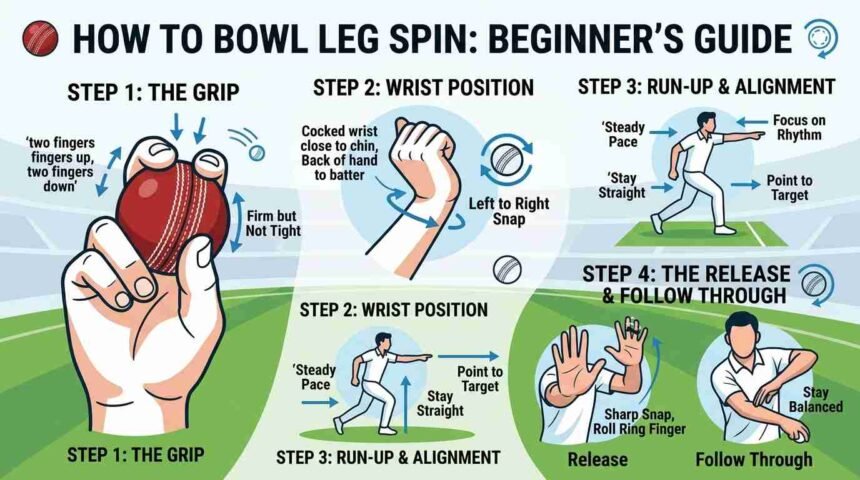
Step 1: Master the Grip First
Everything starts with the grip. Get this wrong, and nothing else will work properly.
Here’s how to hold the ball correctly:

- Place the ball in the palm of your hand, with the seam running across your fingers.
- Rest your index and middle fingers on top of the seam, spread slightly apart.
- Curl your ring finger against the side of the ball. This finger does most of the work.
- Let your thumb rest lightly on the other side. It shouldn’t apply much pressure.
Your grip should feel firm, but not tight. A tight grip restricts wrist movement, and wrist movement is where all your spin comes from.
Practice this grip without even bowling at first. Just hold the ball, and get used to how it feels. According to Inside Sport’s leg spin guide, a simple way to remember the grip is “two fingers up, two fingers down.” Spend time simply spinning the ball to yourself before you ever try a full delivery.
Step 2: Learn the Wrist Position
The wrist is the single most important part of leg spin bowling. Everything else supports it.
As you begin your delivery stride, your wrist should be “cocked.” That means bent backward, with the back of your hand facing the batter. Keep it close to your chin or chest as you jump into your action.
This cocked position stores energy. Right before release, you snap the wrist sharply from right to left. That snap is what generates the spin. According to Wikipedia’s wrist spin entry, this sharp wrist movement, combined with the ring finger, creates the leg break’s signature turn.
Beginners often rush this step. Don’t. A relaxed, well-timed wrist snap beats a rushed, tense one every time.

Step 3: Build a Simple, Repeatable Run-Up
Your run-up doesn’t need to be long or complicated. Many great leg spinners use a short, simple approach.
Keep these points in mind:
- Start with a steady, controlled pace. You’re not sprinting in like a fast bowler.
- Stay balanced through each step. Avoid leaning too far in any direction.
- Focus on rhythm over speed. A smooth run-up sets up a smooth release.
A shorter run-up also makes it easier to repeat your action consistently. Consistency matters more in leg spin than raw pace ever will.
Step 4: Get Your Body Alignment Right
As you enter your delivery stride, your body needs to align toward the target. This step gets overlooked a lot, but it directly affects your accuracy.
Pull your body toward the target as you load into the delivery stride. Keep your shoulders straight and square. Reach out toward the target with your bowling arm, almost like you’re pointing at where you want the ball to land.
Then pull your arm in close to your side as it comes over, similar to how a fast bowler generates power. This keeps your body tall and upright, rather than falling sideways. Falling sideways is one of the most common technical flaws in beginner leg spinners, and it kills both accuracy and spin.
Step 5: The Release
This is where everything comes together. Grip, wrist position, run-up and alignment all lead to this single moment.
At the point of release, snap your wrist sharply while your ring finger rolls off the side of the ball. Your palm should face the batter as the ball leaves your hand. The ball should come out almost like you’re snapping your fingers, not just letting it roll off passively.
Give the ball some height and flight as you release it. A flatter, faster ball is easier to hit. A ball with some loop gives it more time to dip and turn after it bounces, which is exactly what makes leg spin so difficult to face, especially for batters who are more used to facing pace bowling and haven’t developed strong footwork against flighted deliveries yet.
Step 6: Follow Through Properly
Don’t stop your motion right after release. Let your bowling arm continue naturally across your body.
A proper follow-through does two things. First, it protects your shoulder and elbow from unnecessary strain. Second, it helps you stay balanced, which improves your next ball’s accuracy. According to Wikipedia’s bowling action entry, spin bowlers often finish with their wrist at different angles depending on the type of spin they’re trying to create, so pay attention to where your hand naturally ends up.
The Stock Ball: Understanding the Leg Break
The leg break is your bread-and-butter delivery. It’s the ball you’ll bowl most often, and the one every other variation is built from.
A leg break spins away from a right-handed batter, moving from leg side to off side after it pitches. According to a detailed technique breakdown, the key elements are a light grip, a sharp wrist snap at the right angle, and a smooth follow-through.
Master this delivery completely before worrying about variations. Many beginners rush into learning a googly or a flipper before they can consistently land a normal leg break. That’s a mistake. Get your stock ball rock solid first.
Learning Your First Variation: The Googly
Once your leg break feels natural, the googly is usually the next delivery to learn.
A googly spins the opposite way to a normal leg break. It looks identical out of the hand, which is exactly why it works. According to Wikipedia’s googly entry, this delivery is one of the leg spinner’s most important wicket-taking weapons, precisely because its effectiveness relies on surprise.
To bowl it, you cock your wrist differently than usual, so the back of your hand faces the batter at release instead of your palm. This subtle change reverses the spin direction completely.
Don’t rush this delivery. It takes real time to disguise properly, and an obvious googly is far less dangerous than a well-hidden one.
Other Variations Worth Learning Later
Once you’ve built confidence with the leg break and the googly, a few more deliveries are worth adding to your arsenal over time.
- Top spinner: Spins forward rather than sideways, making the ball bounce higher and more steeply.
- Slider (or “zooter”): Skids on after pitching, with very little turn, catching batters off guard who expect sideways movement.
- Flipper: A faster, flatter ball that skids through low, often used as a surprise wicket-taking delivery.
These variations take much longer to master than the basic leg break. Beginners shouldn’t feel pressure to learn all of them right away. Focus on one at a time, and only once your stock delivery is genuinely reliable.
Transitioning From Nets to Match Play
Bowling well in the nets doesn’t always translate immediately to match performance. A few adjustments help bridge that gap.
In the nets, there’s no real pressure and no fielders to consider. In a match, you need to bowl to an actual field, factor in the game situation, and manage pressure from both the batter and the scoreboard. Start by bowling a few overs in the nets while imagining a real field setting, planning each delivery as if it mattered, rather than just focusing on pure technique.
Bowling in full overs during practice, rather than isolated deliveries, also helps. According to PitchVision’s spin bowling drills, working with a wicketkeeper and bowling complete overs builds the rhythm and game-awareness that isolated drilling alone can’t fully replicate.
Expect your first few match overs as a new leg spinner to feel different from net practice. That’s completely normal. Confidence and comfort under real match pressure build gradually, the same way your technique does, and most bowlers need several full matches before an over in a real game starts to feel as natural as one bowled in the nets.
Bowling Leg Spin to Left-Handed Batters
Everything changes slightly when you’re bowling to a left-hander. Your leg break now spins into the batter rather than away from them, which changes the entire dynamic of the delivery.
Many leg spinners actually prefer bowling to left-handers, since the ball turning into the pads creates more lbw opportunities. Your googly becomes the delivery that spins away from a left-hander instead, effectively swapping roles compared to bowling at a right-hander.
Adjust your field accordingly too. A leg slip position that made little sense against a right-hander might become a genuine wicket-taking option against a left-hander, depending on how the ball is turning that day.
How Pitch and Weather Conditions Affect Your Bowling
Leg spin is heavily influenced by the surface you’re bowling on. Understanding this helps you adjust your plans on the day, rather than bowling the exact same way regardless of conditions.
A dry, worn pitch offers far more grip and turn than a fresh, hard surface. On these pitches, you can afford to bowl with more loop and invite the batter to take risks, since the ball is doing plenty of work off the surface already. This is often the ideal condition for a beginner to build confidence, since even a slightly imperfect delivery can still produce meaningful turn.
A flat, true pitch demands more precision. You’ll need to rely more heavily on subtle variations and changes of pace, since natural turn alone won’t trouble a well-set batter as much.
Humid or overcast conditions can also affect grip on the ball itself. Keep a dry towel handy during matches, and don’t be afraid to adjust your grip pressure slightly if the ball feels harder to control than usual.
Choosing the Right Ball and Equipment
Your equipment matters more than many beginners realize, especially early in your development.
A slightly worn ball, rather than a brand new one, is often easier to grip and spin for a beginner still building wrist strength and control. Newer balls tend to be harder and more slippery, which can make early practice sessions more frustrating than they need to be.
Some young spinners also benefit from starting with a slightly smaller or lighter ball, such as a junior cricket ball, before transitioning to a full-sized adult ball once their grip strength develops. There’s no shame in this approach. It’s far better to build correct technique with an appropriately sized ball than to develop bad habits fighting against equipment that’s too demanding too soon.
Common Mistakes Beginners Make
A few technical errors show up again and again in new leg spinners. Watching for these early can save you months of frustration.
Losing turn while chasing accuracy. Some beginners flatten out their action to gain control, but this kills spin completely. According to PitchVision’s coaching resources, this is one of the most common issues young spinners face, and it doesn’t need to happen. Turn and accuracy can both improve together with the right drills.
Rotating the bowling arm backward. This pulls your body away from the target and destroys your balance. A proper action keeps your arm working in a straight, controlled path toward the batter.
Gripping the ball too tightly. A tense grip restricts wrist movement, which directly reduces the amount of spin you can generate.
Rushing the wrist snap. Trying to force extra spin by snapping too early or too hard usually backfires, leading to loss of both control and turn. A relaxed, well-timed snap almost always outperforms a forced, tense one, even though it can feel counterintuitive early on.
Ignoring flight completely. Bowling flat, fast leg breaks without any loop makes the ball far easier to hit, even if it still turns sharply off the pitch. Beginners often make this mistake because a flatter ball feels easier to control, but it sacrifices one of leg spin’s biggest natural advantages over the batter.
Practice Drills for Beginners
Drills build muscle memory. Muscle memory is what eventually makes your action feel automatic rather than mechanical.
Grip and Spin Drill
Spend ten minutes a day simply spinning the ball in your hand, without bowling at all. Try spinning it hard enough that it comes back toward you off the ground. According to CricHeroes’ beginner guide, this simple daily habit builds finger and wrist strength naturally over time.
Wall Spin Drill
Throw the ball against a wall using your leg-spin wrist action, focusing purely on generating spin rather than pace. Any round object works for this drill, even something like an orange, according to multiple coaching guides.
String Drill for Flight and Dip
Set up two pieces of string across the practice area, one about 7 yards down the pitch and another around 14 yards down. Try to flight the ball over the first string and dip it below the second, before it lands on your target area. This helps build the natural loop that makes leg spin so difficult to face, according to PitchVision’s spin bowling drills.
Bowling in Sequence
Rather than obsessively practicing one variation for weeks at a time, bowl your deliveries in a rotating sequence: stock ball, top spinner, googly, and any others you’re working on. This prevents you from losing your basic action while chasing a new variation.
Fielding Off Your Own Bowling
Practice fielding immediately after your delivery. Have a partner hit or throw the ball back the moment it bounces. This builds reflexes and gets you used to reacting quickly right after your bowling action finishes.
For a broader library of structured drills covering grip, run-up, accuracy and variations, Sixes Cricket’s drill breakdown is a useful resource to build a complete weekly practice routine around.
How Long Does It Take to Learn Leg Spin?
There’s no fixed timeline here. Leg spin is widely considered one of the hardest skills in cricket to master, and even experienced coaches say it takes years to fully develop.
That said, most beginners can build a reasonably consistent leg break within several months of regular practice. Learning to disguise a googly convincingly usually takes considerably longer. Be patient with yourself. Even top international leg spinners spent years refining their action before it became a genuine wicket-taking weapon.
Building the Right Fitness for Spin Bowling
Leg spin doesn’t demand the same raw power as fast bowling. But it still requires real physical conditioning, especially in the wrist, forearm and shoulder.
Simple resistance band exercises can help strengthen your wrist snap specifically. Hold a light resistance band in your bowling grip, and practice the snapping motion repeatedly, as if releasing a ball. According to GoCricit’s training guide, this kind of targeted wrist strengthening directly improves both spin and control over time.
Core stability also matters more than most beginners realize. A stable core supports proper body alignment through your delivery stride, which directly affects your accuracy.
Basic Field Placements for a Leg Spinner
Once you can land the ball consistently, understanding field placement becomes important. A leg spinner typically needs a slightly different field setup than a fast bowler or a finger spinner.
Common beginner-friendly leg spin fields include a slip and a short leg to catch mistimed shots off the turn, a deep square leg to guard against the ball being turned around the corner, and a mid-on or mid-off to prevent easy singles down the ground. As your control improves, you can adjust your field to attack more aggressively, bringing fielders closer for a genuine wicket-taking opportunity, rather than setting a purely defensive field designed only to limit runs.
Learning From the Greats
Studying great leg spinners is one of the best ways to speed up your own development. Watching how they set up batters, disguise variations, and control flight gives you real reference points beyond just technical instructions.
Shane Warne remains the standard most coaches point new leg spinners toward, thanks to his exceptional control, drift and ability to set batters up over an entire spell. Anil Kumble showed how a slightly different, quicker style of leg spin could still be devastatingly effective. Studying video of bowlers like these, alongside your own practice, helps connect the technical steps in this guide to how they actually look in a real match situation. Pay particular attention to how experienced leg spinners vary their pace and flight from ball to ball, since this variation is often what separates a genuinely dangerous spinner from one who is simply technically correct but predictable.
Mental Side of Leg Spin Bowling
Leg spin isn’t just physical. It’s one of the most mentally demanding roles in cricket too.
Unlike fast bowling, where raw pace can succeed even with an average plan, leg spin relies heavily on out-thinking the batter. You need to set up dismissals over several deliveries, not just one ball at a time. Expect to get hit occasionally, even when your technique is sound. That’s part of the format. The best leg spinners accept some risk in exchange for a genuine chance at taking wickets, rather than bowling purely defensively.
Confidence matters enormously here. A nervous, tentative leg spinner almost always bowls worse than one who commits fully to their action, even if the technical skill level is similar. Try to treat each over as a fresh opportunity rather than dwelling on a boundary conceded two balls earlier. That mental reset is often what separates bowlers who recover well within a single spell from those who spiral after one bad delivery.
How to Track Your Progress
Recording your bowling action on video is one of the most useful habits you can build early. Watching yourself back reveals flaws that are almost impossible to notice while you’re actually bowling.
Pay close attention to your wrist position at release, your body alignment through the crease, and your follow-through. Compare your action over time, not just against a single ideal model, since every bowler’s natural action looks slightly different. Reviewing footage from several weeks apart, rather than session to session, often reveals genuine progress that’s harder to notice day to day.
For fans and young players in South Asia specifically looking for more cricket coaching content and skill breakdowns, SportsTamasha regularly covers technique guides across multiple cricket disciplines, worth bookmarking alongside your regular practice routine.
Frequently Asked Questions: How to Bowl Leg Spin
Is leg spin bowled with the wrist or the fingers?
Leg spin relies primarily on the wrist. The ring finger also plays an important supporting role in generating spin, but the wrist snap is what creates most of the turn.
How do I hold the ball for a leg break?
Place the ball in your palm with the seam running across your fingers. Rest your index and middle fingers on the seam, curl your ring finger against the side of the ball, and let your thumb rest lightly without applying pressure.
Why does my leg spin not turn much?
A tight grip, a rushed wrist snap, or flattening your action to gain control are the most common reasons beginners lose turn. Focus on a relaxed grip and a well-timed wrist flick rather than trying to force extra spin.
Should beginners learn the googly right away?
No. Master the standard leg break first. Learning variations too early often weakens your basic action, and a well-disguised googly takes real time to develop properly.
How long does it take to learn leg spin bowling?
Most beginners can build a reasonably consistent leg break within several months of regular practice, though disguising variations like the googly usually takes considerably longer.
What’s the difference between leg spin and off spin?
Leg spin relies mainly on wrist action and turns from leg side to off side for a right-handed batter. Off spin relies mainly on finger action and turns the opposite way, from off side to leg side.
What field settings work best for a beginner leg spinner?
A slip, a short leg, a deep square leg and a mid-on or mid-off are common starting points, helping cover both mistimed shots and easy singles while you build control.
Do I need special fitness training for leg spin bowling?
Wrist and forearm strength exercises, along with general core stability work, help improve both spin generation and control, even though leg spin doesn’t require the same raw power as fast bowling.
Can adults learn leg spin bowling, or is it only for young players?
Adults can absolutely learn leg spin bowling. It takes patience and consistent practice at any age, though building the specific wrist strength and flexibility may take a bit longer to develop later in life.
What’s the best drill for beginners just starting out?
Simply spinning the ball in your hand daily, without bowling at all, is one of the most effective early habits. It builds grip comfort and finger strength before you even worry about your full bowling action.
Does the type of ball I use matter as a beginner?
Yes, somewhat. A slightly worn ball is often easier to grip and spin than a brand-new one, and younger players may benefit from a smaller or lighter ball while building wrist strength.
Is leg spin bowling different against left-handed batters?
Yes. Your stock leg break spins into a left-hander rather than away from them, and your googly effectively swaps roles, spinning away from a left-hander instead.
Learning how to bowl leg spin takes patience, but the steps themselves aren’t complicated. Master your grip first. Build a relaxed, well-timed wrist snap. Keep your run-up simple and your body alignment straight. Then add flight and follow-through to bring it all together.
Don’t rush into variations before your stock ball is reliable. And don’t get discouraged by early inconsistency. Every great leg spinner went through the same frustrating early months. Stick with the drills in this guide, track your progress on video, and give yourself real time to develop.
Pay attention to conditions too. Adjust your plans for the pitch, the weather, and whether you’re bowling to a right-hander or a left-hander. These small adjustments separate a bowler who simply knows the technique from one who can genuinely trouble batters in a real match. Leg spin might be difficult to learn, but it’s one of the most rewarding skills in the entire sport once it clicks.