


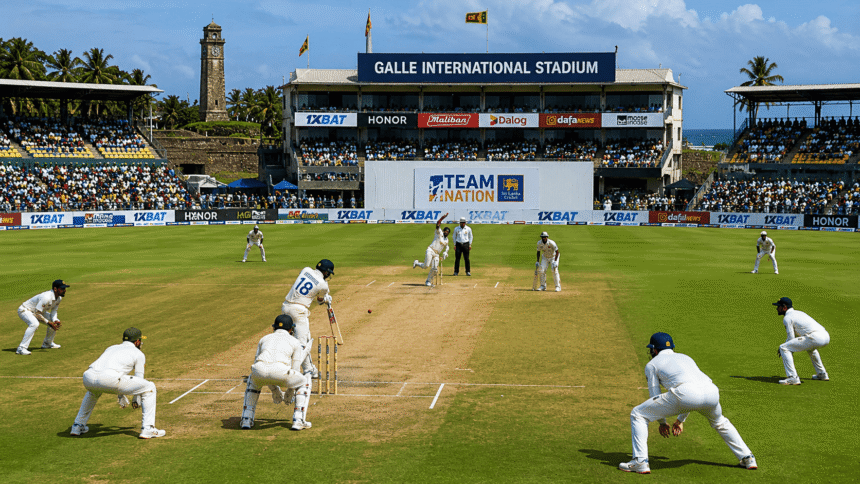
Test cricket does not slow down for anyone, and the latest reminder of that arrives in Galle, where Sri Lanka and India open a new World Test Championship series carrying squads that look considerably different from their strongest available line-ups. Both teams enter this contest managing injuries to key personnel, turning what should be a straightforward assessment of form into a genuine test of depth.
Galle has long been one of the most distinctive venues in world cricket. The historic fort ground, with its ocean backdrop and characteristically dry, turning surface, rewards patient batting and disciplined spin bowling in equal measure. For a series billed as a litmus test for both sides in the current WTC cycle, there is no more fitting stage.
Sri Lanka vs India Test Series: Key Details
| Detail | Information |
|---|---|
| Competition | ICC World Test Championship 2025-27 cycle |
| Venue | Galle International Stadium |
| Format | Multi-Test series |
| Context | Both squads affected by injuries ahead of the first Test |
| Surface | Historically spin-friendly, low and slow |
Why This Series Matters for the WTC Table
The World Test Championship has changed the way bilateral Test series are consumed by fans and analyzed by teams. Every session now carries weight beyond the immediate result, because points earned or dropped in Galle directly affect a team’s position on the global standings and, ultimately, its path toward a place in the championship final.
For India, that context is particularly sharp. Few nations have built their reputation in the WTC era as thoroughly as India has, consistently finishing among the top sides in the table since the championship’s inception. A series in Sri Lanka, traditionally a tricky away assignment given the conditions, represents exactly the kind of fixture that can define a campaign either positively or negatively.
Sri Lanka, meanwhile, have their own incentive to protect home advantage. Galle is as close to a fortress as Sri Lankan cricket has, and a home nation that can lean on conditions it understands intimately gives itself a genuine chance of picking up crucial points against one of the strongest touring sides in world cricket.

Injuries Force Both Camps to Adjust
Neither team arrives at full strength, and that reality shapes almost every tactical conversation ahead of the opening Test. Squad depth becomes the deciding factor in series like this one, where the difference between a first-choice bowling attack and a reserve option can be the difference between exploiting Galle’s surface and being exploited by it.
For touring sides, missing key personnel in Sri Lanka is a particularly difficult problem because success there so often depends on specialists: spinners who understand exactly how much turn to expect on a given day, and batters comfortable playing spin for long periods without the release shots available on faster, bouncier pitches elsewhere in the world.
For the home side, injuries carry a different kind of risk. Sri Lanka’s recent Test sides have leaned heavily on a core group of experienced campaigners who understand Galle’s conditions instinctively. Losing any of that experience forces less experienced players into high-pressure situations from the very first ball of the series.
Galle’s Conditions Will Shape the Contest
Anyone who has followed Test cricket at Galle understands why it produces some of the most compelling passages of play in the sport. The pitch tends to offer turn from the very first day, and that turn typically increases as the match progresses, putting a premium on winning the toss and batting first when conditions are at their most benign.
Spin bowlers on both sides will be central to the outcome. Sri Lanka’s tradition of producing quality slow bowlers capable of exploiting Galle’s surface is well established, while India’s own spin resources have become one of the most feared bowling units in world cricket over the past decade, particularly in home and subcontinental conditions.
Batting depth becomes just as important as bowling craft in these conditions. Sessions can turn quickly once the ball starts gripping and turning sharply, meaning batting line-ups need patience and technical solidity through the middle order rather than simply relying on top-order stars to see off the shine.
What a Result in Galle Would Mean
A series win for India would reinforce their status as one of the most consistent touring sides in world cricket, adding further weight to their WTC campaign and extending a pattern of performing away from home even when squads are not at full strength. It would also continue a broader era of Indian Test dominance that has defined much of the WTC’s short history.
A series win for Sri Lanka, by contrast, would represent a significant statement of home-conditions mastery against one of the toughest possible opponents. Beating India in a bilateral series carries substantial prestige regardless of format, and doing so in a WTC context would meaningfully boost Sri Lanka’s own standing in the championship table.
The Bigger Picture: Test Cricket’s Packed Calendar
This series arrives during an unusually dense period for red-ball cricket, with several major Test series being played in close proximity around the world. That scheduling reality places extra strain on players managing workload across formats, and it is one of the reasons injury management has become such a prominent storyline heading into major series like this one.
For fans, the crowded calendar is a reminder of how much red-ball cricket remains a central part of the sport’s identity even in an era dominated by short-format leagues. A five-day contest at a ground as historic as Galle, between two nations with a long and competitive Test history, still carries a weight that few other formats can replicate.
What to Watch as the Series Begins
The toss will matter enormously in Galle, given how conditions typically deteriorate for batting as matches progress. Expect both captains to prioritize winning it and batting first wherever possible, setting up sessions two, three and four as the moments where spin bowlers on both sides look to seize control.
Player workload management will also be worth tracking closely. With both squads carrying injury concerns into the series, how each team rotates bowlers and manages returning players across a multi-Test series could ultimately decide who controls the WTC points on offer.
Where is the Sri Lanka vs India Test series being played?
The series opens at the Galle International Stadium, one of Sri Lanka’s most historic and spin-friendly Test venues.
Why does this series matter for the World Test Championship?
Results directly affect both teams’ points and percentage in the WTC standings, which determine qualification for the championship final.
Are both teams at full strength for this series?
No. Both India and Sri Lanka enter the series managing injuries to key players, affecting squad selection.
What kind of pitch does Galle typically produce?
Galle is known for a dry, low, spin-friendly surface that tends to offer increasing turn as a Test progresses.
Has India traditionally performed well in Sri Lanka?
India have been one of the most consistent touring sides in world cricket during the WTC era, though Sri Lanka’s home conditions at Galle have historically posed a genuine challenge for visiting teams.