

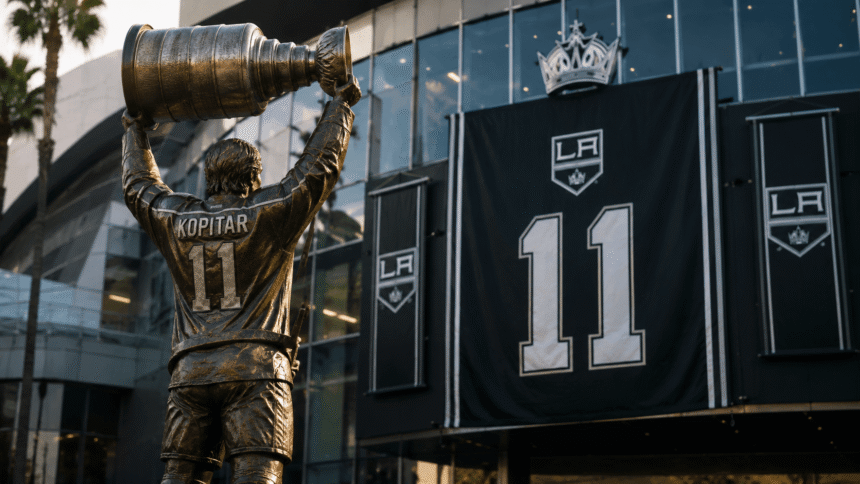
Twenty seasons is an eternity in professional hockey, and almost none of the sport’s modern stars spend an entire career with a single franchise. Anze Kopitar did exactly that with the Los Angeles Kings, and the organization is honoring the length and weight of that loyalty in the two most permanent ways a franchise can: retiring his No. 11 and building a bronze statue outside Crypto.com Arena.
For a franchise that spent much of its early history struggling for national relevance, Kopitar’s two decades represent a golden era. Two Stanley Cup championships, sustained playoff contention across most of his career, and a captaincy defined by quiet consistency rather than headline-grabbing controversy all combine to make him arguably the most important player in franchise history.
The Honor at a Glance
| Detail | Information |
|---|---|
| Player | Anze Kopitar |
| Franchise | Los Angeles Kings |
| Career length | 20 seasons, entirely with the Kings |
| Number retired | No. 11 |
| Championships | Two Stanley Cups |
| Additional honor | Bronze statue outside Crypto.com Arena |
A Rare Kind of Loyalty in Modern Hockey
Free agency, trade demands and salary cap pressures have made one-franchise careers increasingly rare across the NHL, particularly for players of Kopitar’s caliber who could easily have commanded lucrative offers elsewhere at various points in their careers. That Kopitar chose to stay in Los Angeles for the entirety of his professional life speaks to both his own values and the organization’s ability to build a culture worth staying for.
Drafted by the Kings and developed within the organization from a young age, Kopitar grew alongside the franchise’s evolution from a team fighting for relevance in a non-traditional hockey market to one of the most respected organizations in the league. That growth culminated in the Kings’ two Stanley Cup championships, both won with Kopitar as a central figure in the locker room and on the ice.
Why a Statue, Not Just a Banner
Retiring a jersey number is the standard way professional franchises honor legendary players, and the Kings are doing that for Kopitar. But the decision to also commission a bronze statue outside the arena elevates the tribute to a smaller category of honors reserved for players considered foundational to a franchise’s entire identity.

Statues carry a different kind of permanence than a banner hanging from the rafters. They exist outside the arena, visible to fans on non-game days, becoming part of the physical landscape surrounding the building itself. For a franchise choosing to memorialize a player this way, the message is clear: Kopitar is not just a great player who wore the jersey for a long time, but a figure the organization considers central to what the Kings represent as a franchise.
The On-Ice Legacy
Statistically and competitively, Kopitar’s career places him among the most accomplished two-way centers of his generation. Across two decades, he built a reputation as a complete player, capable of driving offense while also being trusted defensively in critical situations, a combination that made him a fixture on the Kings’ top line and penalty-killing units alike for the majority of his career.
His leadership as team captain further cemented his standing within the organization. Captains in professional hockey are often judged not just by their individual production but by how they shape a locker room’s culture over multiple seasons, particularly through difficult rebuilding stretches as well as championship runs. Kopitar’s tenure spanned both extremes, giving him a rare vantage point on the franchise’s full arc over the past twenty years.
What This Means for the Kings’ Organizational Identity
Franchise cornerstones like Kopitar often become reference points for how an organization wants to be perceived, both by its own fans and by prospective free agents evaluating where to build their careers. A player choosing to stay for two decades, culminating in permanent recognition through both a retired number and a statue, sends a message about organizational stability and loyalty that can influence how future players view the Kings as a long-term destination.
That kind of institutional messaging matters increasingly in a league where player movement has become the norm rather than the exception. Franchises that can point to examples of stars staying, thriving and being permanently honored for that loyalty have a genuine recruiting advantage in an era of frequent roster turnover.
A Ceremony Befitting a Two-Decade Career
Jersey retirement ceremonies for players of Kopitar’s stature typically become organizational events that go well beyond a simple pregame presentation, often drawing former teammates, coaches and franchise executives from across his career to celebrate the full scope of his contribution. Given the length of Kopitar’s tenure, the guest list for such an occasion would realistically span multiple eras of Kings hockey, from teammates on his earliest rosters through to players who shared the ice with him in his final seasons.
The unveiling of the statue itself adds another layer to the celebration, giving fans a permanent physical space to gather, take photographs and reflect on Kopitar’s era whenever they visit Crypto.com Arena going forward, long after the ceremony itself has passed into franchise history.
Where Kopitar Fits Among Franchise Legends
Every NHL franchise with sufficient history eventually builds its own pantheon of retired numbers and honored greats, and the decision to add a statue alongside Kopitar’s number retirement suggests the Kings view him as occupying a tier above the franchise’s other honored players. That distinction, reserved for players considered truly transformational rather than simply excellent, places Kopitar in rarefied company within the broader history of the Los Angeles franchise.
How many seasons did Anze Kopitar play for the Kings?
Kopitar played 20 seasons, spending his entire NHL career with the Los Angeles Kings.
What number is being retired?
The Kings are retiring Kopitar’s No. 11.
How many Stanley Cups did Kopitar win?
Kopitar won two Stanley Cup championships with the Kings.
Where will Kopitar’s statue be located?
The bronze statue will be unveiled outside Crypto.com Arena, the Kings’ home venue.
Was Kopitar ever traded during his career?
No. Kopitar spent his entire two-decade career with the Los Angeles Kings, never having played for another NHL franchise.